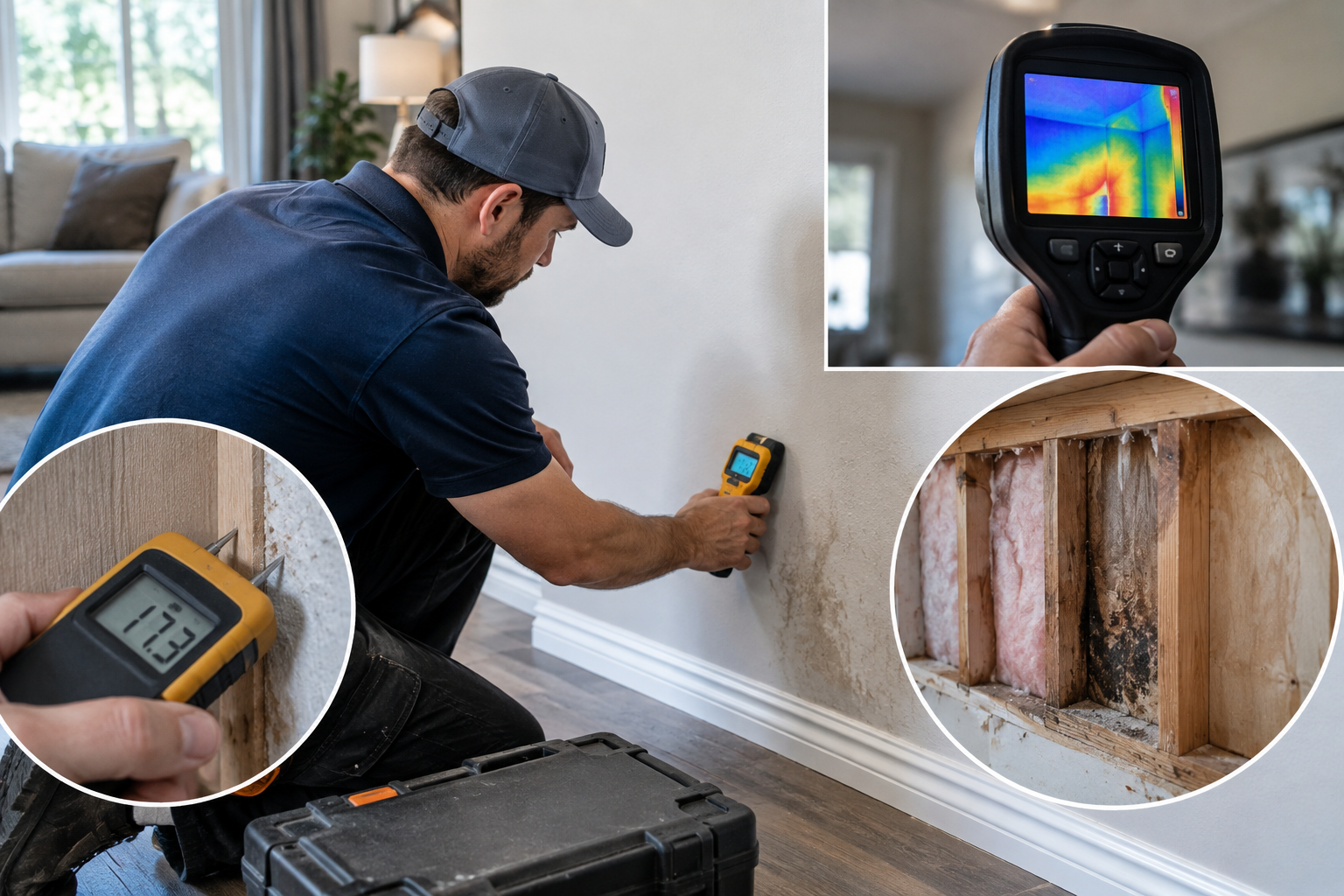


Not all water damage announces itself with standing water or a dripping ceiling. Sometimes the first warning is quieter. A musty smell that keeps coming back. A patch of discoloration you don't remember. A floorboard that feels a little different underfoot than it did last month.
These small changes are easy to explain away, and most of the time homeowners do exactly that. The trouble is that water moves. It follows gravity, it wicks into porous materials, and it settles into places you were never going to look: behind drywall, under flooring, around cabinet bases, along baseboards, near plumbing runs, and around HVAC components.
So a homeowner can do everything right on the surface. Soak up the puddle, dry the floor, wipe down the wall. And still have moisture sitting somewhere out of sight, slowly working on the materials your home is built from.
This article walks through eight warning signs that hidden moisture may be present, why it's so easy to miss, and how to know when it makes sense to bring in a professional to check.
In This Article
1Musty Odors That Don't Go Away
Your nose often notices moisture before your eyes do. A persistent musty or earthy smell, especially one that returns after you've cleaned and aired out a room, can be a reason to look closer.
Pay attention to smells that seem anchored to one spot in the house:
- Bathrooms, especially around the base of the toilet, tub, or vanity
- Kitchens, particularly under the sink and behind the dishwasher
- Closets that share a wall with a bathroom or laundry room
- Areas near plumbing runs, water heaters, or washing machine hookups
- Enclosed spaces like pantries, crawl space access points, and utility rooms
To be clear, not every musty smell means water damage. Some spaces simply don't get much airflow. But when a smell keeps coming back to the same location no matter what you do, it's telling you something is different about that spot. Trapped moisture is one of the more common explanations, and it's worth ruling out rather than covering up with air freshener.
2Warping or Bubbling on Walls, Floors, or Ceilings
Building materials are honest. When they absorb moisture, they change shape, and those changes show up in ways you can spot if you know what to look for:
- Paint that bubbles, blisters, or starts peeling in patches
- Baseboards that warp, separate from the wall, or swell at the joints
- Crown molding that develops gaps or pulls away from the ceiling
- Flooring that cups, crowns, or feels uneven where it used to be flat
- Drywall or ceiling sections that appear to sag or ripple
These changes usually happen gradually, which is exactly why they get missed. You walk past the same baseboard every day, and a slow bow over several weeks doesn't register the way a sudden change would.
A useful habit: when you notice one of these changes, ask yourself what's on the other side of that surface. A bathroom? A plumbing wall? An exterior wall that takes snowmelt runoff? Materials don't warp for no reason, and moisture is one of the most common causes worth investigating.

3An Unexpected Increase in Your Water Bill
Sometimes the first evidence of a hidden leak never shows up on a wall at all. It shows up on paper.
If your water bill jumps noticeably and nothing about your household has changed, no guests, no new irrigation schedule, no filling the hot tub, that gap between usage and explanation deserves a closer look. A slow leak inside a wall, under a slab, or in a supply line can run continuously, and continuous adds up fast.
A high bill doesn't automatically mean hidden water damage. Rate changes, seasonal watering, and simple billing corrections explain plenty of spikes. But an unexplained increase is a data point, and one worth investigating rather than shrugging off.
One simple check: turn off every fixture and appliance that uses water, then look at your water meter. If it's still moving, water is going somewhere, and it's worth finding out where before that water finds its way into your building materials.

4Stains That Keep Appearing
A single old water stain isn't necessarily alarming. Maybe it's from a roof issue that was fixed years ago. The stains that deserve your attention are the ones that change: they grow, they darken, they come back after you paint over them, or new ones appear nearby.
Keep an eye out for:
- Yellow or brown rings on ceilings, especially below bathrooms
- Gray or darkened patches on walls
- Discoloration around window frames after snow or heavy rain
- Staining near vents or registers
- Marks that creep up from baseboards or down from ceiling corners
A stain that returns after being painted over is particularly telling. Paint covers the symptom, not the source. If moisture is still reaching that spot, the stain reappears, and its return is useful information: whatever caused it the first time is likely still active.
Take a photo when you first notice a stain and date it. Comparing photos a few weeks apart removes the guesswork about whether it's growing.

5Mold or Mildew in Unexpected Places
A little mildew on a shower curtain or around a tub isn't unusual. Bathrooms are humid places. What's worth paying attention to is mold or mildew showing up where it doesn't belong:
- On a bedroom or hallway wall
- Inside a closet, on shoes or stored items
- Along baseboards in living areas
- On ceilings away from bathrooms
- Behind or underneath furniture that sits against an exterior wall
Mold needs moisture to grow. So when it appears somewhere unexpected, the more important question isn't the mold itself, it's where the moisture is coming from. Growth in an odd location suggests water is reaching that area from somewhere, and often from somewhere you can't see.
Wiping the surface may make the room look better for a while, but if the underlying moisture remains, the growth tends to return. Finding and resolving the moisture source is what actually addresses the issue.

6Cracked or Deteriorating Caulking and Grout
Caulk and grout have one job: keeping water on the side of the surface where it belongs. When they crack, shrink, or crumble, that barrier is compromised, and every shower, every dishwashing session, every splash gets a chance to migrate somewhere it shouldn't.
The usual suspects:
- The caulk line where the tub or shower pan meets the floor
- Grout joints in shower walls and floors
- Caulking around sinks and faucets in bathrooms and kitchens
- The seam where a kitchen countertop meets the backsplash
- Around tub spouts and shower valves
Not every cracked joint means major water damage is underway. Caulk ages, homes settle, and small gaps are a normal maintenance item. The concern is time. A failed seal in a spot that gets wet daily gives water a repeated, reliable path behind tile and under flooring, and what accumulates back there is exactly the kind of moisture no one sees until secondary signs appear.
Re-caulking a failed joint is inexpensive. What's worth thinking about is how long the joint was failed before you caught it, and whether anything got in during that window.
7Soft, Spongy, or Uneven Flooring
Your feet collect data all day. Trust them.
Flooring that has absorbed moisture often changes in ways you feel before you see:
- A soft spot where the floor used to feel solid
- A spongy or slightly springy area, often near a tub, toilet, or exterior door
- A subtle bounce underfoot in one section of a room
- Boards or tiles that sit slightly higher or lower than their neighbors
These changes can indicate that moisture has reached the subfloor, the structural layer beneath your finished flooring. Because the subfloor is hidden by definition, the surface can look completely normal while the material underneath softens.
If a specific spot in your home feels different than it used to, especially in a bathroom, kitchen, or laundry area, that's a sign worth investigating rather than adapting to. Homeowners often unconsciously start stepping around a soft spot. If you catch yourself doing that, it's time to find out why the spot is soft.
8HVAC or Vent Issues
Your heating and cooling system touches nearly every room in the house, which makes it both a potential moisture source and an early messenger when something is off. Signs worth noting:
- Condensation forming on or around vents and registers
- A musty or damp smell when the system runs
- Visible moisture, rust, or staining around HVAC components
- A noticeable change in airflow from certain vents
- Dripping, gurgling, or other unusual sounds near the unit or ductwork
These symptoms have a range of possible causes, and not all of them involve water damage. A clogged condensate line, a humidity imbalance, and a duct issue each produce overlapping signs. That's precisely why they shouldn't be ignored or self-diagnosed from the couch: the same symptom can be trivial or meaningful depending on the cause.
What makes HVAC-related moisture tricky is location. Condensate lines and ductwork often run through ceilings, walls, and mechanical closets, so when they leak, they leak in concealed spaces first.